Best Project Management Apps in 2026
Best project management apps in 2026 compared for pricing, AI features, and team fit, so you can pick the right tool without the guesswork.
Project management apps have quietly become the backbone of how teams get anything done. Not the flashy kind of backbone either, the boring, load-bearing kind that nobody notices until it’s missing. If you’ve ever tried to run a project through a shared spreadsheet and a dozen Slack threads, you already know why so many teams eventually give in and pick a proper tool.
The problem in 2026 isn’t a shortage of options. It’s the opposite. There are hundreds of project management tools on the market, and most of them now claim to have “AI-powered” this or “smart” that. Some of that is genuinely useful. A lot of it is marketing dressed up as innovation. The market itself has grown fast enough to prove people are taking this seriously: the global project management software space is valued at roughly $11.27 billion this year, and it’s expected to nearly double by 2031, with AI-driven features already making up a sizable chunk of that spend, according to <cite index=”8-1″>industry estimates covering the sector</cite>.
So instead of listing every tool that showed up in a search result, this guide sticks to the ones that consistently earn their keep across different team sizes and industries. You’ll find a breakdown of what actually matters when picking project management software, an honest look at 11 of the strongest options this year, and guidance on matching a tool to how your team really works, not how a sales page says it should.
What to Look for in Project Management Apps in 2026
Before comparing individual tools, it helps to know what separates a good project management app from one that just looks good in a demo. A few things matter more than the rest:
- Core task management. Subtasks, dependencies, due dates, and recurring tasks should feel effortless, not bolted on.
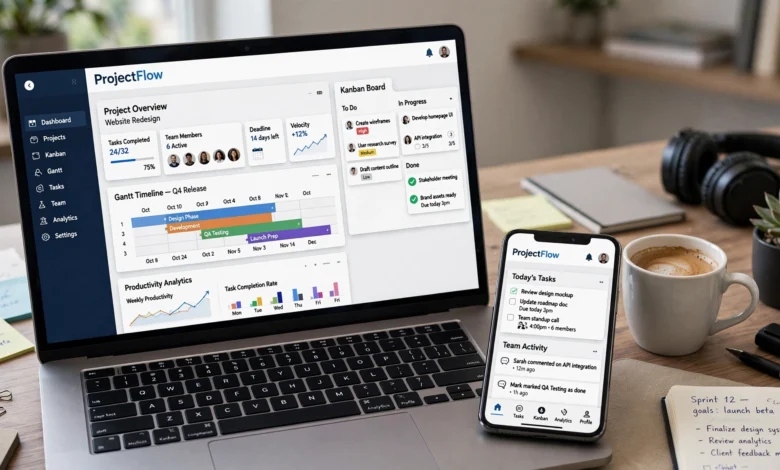
- Multiple views. Kanban boards, Gantt charts, calendars, and list views all serve different thinking styles. A tool that only does one well will frustrate half your team eventually.
- Collaboration features. Comments, file sharing, and @mentions need to live inside the task, not in a separate app you have to tab over to.
- Automation and AI. Automatic status updates, AI-generated summaries, and smart task assignment save real hours when they’re done well.
- Integrations. Your project tool needs to talk to your calendar, your CRM, your storage, and probably Slack. If it can’t, you’ll end up doing manual data entry forever.
- Scalability. A tool that’s great for five people can fall apart at fifty. Check whether pricing and permissions scale sensibly.
- Security. This one gets overlooked constantly, and it shouldn’t. Centralizing your team’s work in one platform also centralizes your risk, and recent security research has found that software vulnerabilities have overtaken stolen credentials as the top cause of data breaches, according to <cite index=”4-1″>Verizon’s 2026 Data Breach Investigations Report</cite>. Pick a vendor that takes this seriously.
Keep these criteria in mind as you go through the list below. The “best” tool isn’t universal. It’s the one that fits your workflow without forcing you to change how your team already thinks.
Best Project Management Apps in 2026
Here’s the rundown. Each of these tools made the list because it’s genuinely strong at something specific, not because it tries to do everything for everyone.
1. monday.com: Best Overall for Visual, Cross-Team Work
monday.com remains one of the most recognizable project management platforms, and for good reason. Its color-coded boards make status tracking almost instantly readable, even for people who’ve never used a PM tool before. The platform has leaned hard into AI over the past year, adding purpose-built agents that monitor active projects and flag risks before they turn into real problems.
What makes monday.com stand out is flexibility. Marketing teams, HR departments, and engineering groups can all use the same core platform without forcing anyone into a workflow that doesn’t fit their job. The tradeoff is that it has fewer native integrations than some competitors, though its app marketplace covers most of the gap.
Best for: teams that want a highly visual, no-code way to build custom workflows across departments.
2. Asana: Best for Non-Technical Teams
Asana has spent years refining itself into one of the most approachable task management apps available, and it shows. New users can figure out how to create a project and assign tasks within minutes, without a training session. That ease of use is a big part of why it’s trusted by large organizations, including companies like Accenture and Amazon, for aligning cross-functional teams.


The platform has also pushed further into what it calls “human and AI coordination,” blending automated workflows with the kind of oversight non-technical teams actually want, rather than the deep configurability that developers tend to prefer.
Best for: marketing, operations, and other non-technical teams that want clarity without complexity.
3. ClickUp: Best for Customization
If monday.com is flexible, ClickUp is almost aggressively customizable. It offers ten different ways to visualize the same data, from Gantt charts to mind maps, and lets teams build workflows that would take significant setup time in other tools. This makes it a favorite among cross-functional teams juggling different project types at once.
The downside of that flexibility is a steeper learning curve. Teams that want something they can pick up in an afternoon might find ClickUp’s sheer number of settings a bit much at first. Once configured, though, it’s hard to beat on raw feature depth.
Best for: teams that want deep customization and don’t mind a short ramp-up period.
4. Wrike: Best for Large, Complex Projects
Wrike is built for scale. It handles large volumes of tasks, dependencies, and stakeholders without buckling, which is why it’s popular with enterprise teams juggling multiple concurrent projects. Its proofing and approval features also make it a strong pick for creative teams that need structured feedback loops on design assets.
Wrike has also built a reputation around integration depth. Teams have pointed to its APIs and automated workflows as reasons it fits cleanly into an existing tech stack rather than requiring a rebuild around it.
Best for: enterprise teams and creative departments managing high-volume, high-complexity projects.
5. Jira: Best for Software and Agile Teams
Jira is still the standard for engineering teams running sprints, tracking bugs, and managing backlogs. Its agile planning tools, from sprint boards to burndown charts, are purpose-built for scrum and kanban workflows in a way that general-purpose tools can’t quite match.
Jira has expanded into broader work management features over the past few years to appeal to marketing, HR, and design teams too. That expansion helps it compete with Asana and monday.com on paper, but the interface still carries a technical, engineering-first feel that non-technical teams sometimes find intimidating.
Best for: software development teams running agile or scrum processes.
6. Smartsheet: Best for Spreadsheet-Style Planning
Smartsheet takes the familiar structure of a spreadsheet and layers proper project management functionality on top: dependencies, automation, and customizable dashboards. For teams that already think in rows and columns, this makes onboarding almost frictionless.
It’s also strong on reporting. Dashboards can be built to show exactly the metrics leadership wants to see, without needing a separate BI tool. That reporting depth is a big reason it shows up so often in enterprise shortlists.
Best for: teams that prefer spreadsheet logic but need more structure and automation than Excel or Google Sheets can offer.
7. Basecamp: Best for Simplicity and Flat Pricing
Basecamp has never tried to be everything. It focuses on straightforward communication and project tracking, wrapped into one all-in-one workspace. Its flat-rate pricing, a single monthly fee regardless of team size, makes budgeting predictable in a way per-user pricing rarely does.
That simplicity is the whole pitch. There’s no AI agent building custom automations here, and there isn’t meant to be. For small businesses and agencies that just want to stop losing track of tasks in email, that’s often exactly what’s needed.
Best for: small businesses and agencies that want simplicity and predictable costs over deep feature sets.
8. Airtable: Best for Data-Heavy Projects
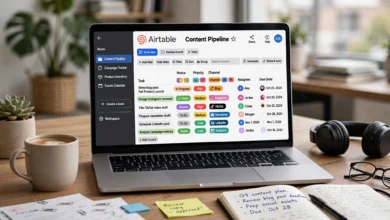
Airtable blends database functionality with project tracking, which makes it unusually good at handling projects with lots of interconnected data: content calendars linked to campaigns, inventory linked to orders, and so on. Its relational structure lets teams connect information across projects in ways a typical task list can’t.
This makes Airtable less of a pure project management tool and more of a flexible database with project management layered on top. Teams that need that flexibility tend to love it. Teams that just want a simple task list might find it overkill.
Best for: teams managing complex, interconnected datasets alongside their projects.
9. Trello: Best for Simple Kanban Boards
Trello remains one of the most recognizable names in this space, and it earns that reputation through sheer simplicity. Its card-and-board Kanban system is intuitive enough for personal task management or small-scale team projects without any real onboarding.
It’s not built for complex dependencies or enterprise reporting, and it doesn’t pretend to be. For freelancers, small teams, or anyone managing a straightforward set of tasks, that lack of complexity is a feature, not a limitation.
Best for: individuals and small teams running simple, visual, Kanban-based projects.
10. Motion: Best AI-First Project Management App
Motion has built its entire pitch around AI. Instead of just adding AI features to a traditional task list, it uses AI to actually build your day, time-blocking tasks directly onto your calendar based on priorities, deadlines, and dependencies. It also includes an AI meeting recorder that turns conversations into approved or denied tasks automatically.
This is a genuinely different approach from most tools on this list, which bolt AI onto an existing structure. Motion inverts that, letting AI drive scheduling from the start. It’s best suited to individuals and small teams who want to lean fully into AI-assisted planning rather than manage everything manually.
Best for: individuals and small-to-mid-size teams who want AI to handle scheduling and prioritization.
11. Teamwork: Best for Client-Facing Agencies
Teamwork was built specifically with client services teams in mind, and it shows in the details: time tracking, budgeting, and reporting are all designed around the reality of billing clients for project work, not just tracking internal tasks. That makes it a strong fit for agencies managing multiple client accounts at once.
Its core project management features cover the basics well, while its broader suite extends into client operations, helping teams manage a project from the first proposal through final delivery and invoicing.
Best for: agencies and client service teams that need billing and reporting built into their workflow.
Project Management Apps by Use Case
Since the “best” tool really does depend on context, here’s a quicker way to match a platform to your situation:
- Small teams and startups: monday.com, Asana, or Trello for straightforward setup and affordable per-user pricing.
- Software development teams: Jira, for agile and scrum support that other tools don’t replicate as well.
- Creative and design teams: Wrike, for proofing and approval workflows.
- Agencies and client services: Teamwork or Basecamp, depending on whether you need detailed billing or just simplicity.
- Enterprise and cross-department rollouts: Smartsheet or ClickUp, for reporting depth and customization at scale.
- Data-heavy or operations-focused teams: Airtable, for its database-style flexibility.
- AI-first individuals and small teams: Motion, for hands-off scheduling.
AI Features in Project Management Apps: What’s Actually Useful
Almost every vendor on this list has added some form of AI in the past year, but not all of it is equally valuable. The features worth paying attention to include:
- Automated task creation from meetings or messages. Turning a conversation into a task list without manual entry saves real time.
- Risk and bottleneck detection. AI agents that scan active projects and flag delays before they escalate are genuinely useful for project managers juggling multiple initiatives.
- Smart scheduling. Tools that can time-block a day around shifting priorities, rather than requiring manual rescheduling, cut down on daily admin work.
- Summarization. AI that condenses long task threads or project updates into a quick summary helps stakeholders stay informed without reading everything.
What’s less useful, in practice, is AI added purely for the marketing checkbox: chatbots that answer questions you could find in three clicks anyway, or “smart suggestions” that just repeat obvious next steps. When evaluating project management apps this year, it’s worth testing the AI features directly during a trial period rather than taking a vendor’s word for it.
Security Should Be Part of Your Decision
It’s easy to treat security as an IT problem rather than a project management one, but centralizing your team’s tasks, files, and communication in a single platform means that platform becomes a serious point of risk if it’s compromised. Software vulnerabilities have become the leading cause of data breaches, ahead of stolen credentials, based on <cite index=”4-1″>recent breach investigation data</cite>. Before committing to any project management software, it’s worth checking a vendor’s security certifications, data encryption practices, and history of incident disclosures. A platform that’s excellent on features but weak on security isn’t a good long-term bet, no matter how nice its dashboards look. You can cross-reference vendor security claims and independent reviews on sites like G2 before making a final call.
How to Choose the Right Project Management App
With this many strong options, the decision usually comes down to a few honest questions:
- How technical is your team? Engineering teams generally do better with Jira, while non-technical teams tend to prefer Asana or monday.com.
- How much customization do you actually need? If your workflows are simple, don’t pay for ClickUp-level flexibility you’ll never use.
- What’s your budget structure? Per-user pricing scales differently than flat-rate pricing. Basecamp’s flat fee can be cheaper for larger teams; per-user tools can be cheaper for small ones.
- Do you need client billing built in? If yes, Teamwork or similar tools save you from stitching together separate invoicing software.
- How much do you actually trust the AI features? Test them yourself during a free trial rather than assuming they’ll work as advertised.
Most vendors offer free trials or freemium tiers, and it’s worth actually running a real project through each shortlisted tool rather than just clicking through a demo. Two weeks of real use will tell you more than any comparison chart, including this one, ever could. For a deeper technical comparison of enterprise-grade options, Gartner’s project management software research is a useful next stop.
Conclusion
Choosing among the best project management apps in 2026 isn’t about finding a single winner, it’s about matching a tool’s real strengths to how your team actually works. monday.com and Asana lead for accessibility and cross-team flexibility, Jira remains the standard for agile software teams, Wrike and Smartsheet handle scale and reporting depth well, and tools like Basecamp, Trello, and Motion serve teams that want simplicity or full AI-driven scheduling.
Whatever you land on, prioritize a genuine trial period, check the AI features actually deliver rather than just exist, and don’t skip the security review, since the platform holding your team’s work together deserves the same scrutiny as any other critical piece of your business.