How to Stop Procrastinating Starting Today
Stop procrastinating with 11 proven habits backed by psychology. Simple, practical steps to beat delay, build focus, and get real work done today.
Most people who want to stop procrastinating already know exactly what they should be doing. The problem is getting themselves to do it. A task sits on the list for days, and every time you glance at it your stomach tightens a little. So you check email, tidy the desk, or watch one more video. Then the deadline arrives and you scramble.
Here is the encouraging part. Research over the past decade has changed how psychologists understand procrastination. It is not mainly a time management problem, and it is not laziness. It is a way of dodging uncomfortable feelings like boredom, self-doubt, or the fear of doing a bad job. Once you see it that way, the fixes start to make a lot more sense.
This guide walks through how to stop procrastinating in practical terms. First you will get a clear picture of why we put things off. Then you will get 11 proven habits you can use starting today, from the two-minute start to the Pomodoro Technique to treating yourself with more kindness when you slip. There is also a section on building a routine that holds up on bad days, and a short note on when putting things off might point to something bigger.
You do not need every idea here. Pick one or two that fit your life, try them this week, and build from there. Small, steady changes are what help people overcome procrastination for good.
Why You Procrastinate (and Why It Is Not Laziness)
If you want to stop procrastinating, start by understanding what is actually going on. Procrastination is choosing to delay something you intend to do, even though you know the delay will probably make things worse. That last part matters. Rescheduling a task because something urgent came up is just planning. Putting it off while you feel guilty about it is procrastination.
Procrastination Is an Emotional Problem First
Psychologists Fuschia Sirois and Timothy Pychyl have spent years showing that procrastination is mostly about managing feelings in the short term. When a task makes you feel anxious, bored, or unsure of yourself, avoiding it brings instant relief. Your brain registers that relief as a win, so it repeats the pattern next time.
This is why productivity apps and color-coded calendars often fail on their own. They organize the work, but they do not touch the uncomfortable feeling that makes you avoid it. A randomized trial on emotion regulation training, published in Learning and Individual Differences, found that teaching people to tolerate and adjust unpleasant emotions led to less procrastination. In other words, getting better at sitting with discomfort is a real, learnable skill.
The Most Common Triggers
Most procrastination habits come from a handful of task features. Notice which ones show up for you:
- The task is boring or tedious. Expense reports, cleaning, data entry. Nothing about them feels rewarding.
- The task is vague. “Work on the website” gives your brain nowhere to begin, so it picks something easier.
- The task is too big. A thesis or a product launch feels like a mountain, so you never take the first step.
- You fear failure or judgment. If the result will be seen by your boss, a client, or a professor, avoiding it protects you from criticism for a while.
- Perfectionism. If it cannot be perfect, part of you would rather not start at all.
- The reward is far away. Saving for retirement or studying for an exam in three months does not feel urgent today.
What Procrastination Costs You
Putting things off feels harmless in the moment, but the costs add up. A Durham University study on procrastination and health followed 379 students over several months and found that the most frequent procrastinators reported more stress and more physical complaints, from headaches to colds. Beyond health, chronic delay tends to hurt work quality, sleep, finances, and relationships. Knowing the stakes will not fix the habit by itself, but it is a useful reason to take the strategies below seriously.
11 Proven Ways to Stop Procrastinating Starting Today
The habits below are ordered roughly from quickest to deepest. The first few can help you stop procrastinating within the next ten minutes. The later ones build lasting change over weeks.


1. Shrink the First Step Until It Feels Easy
The hardest part of any task is starting. So make the start almost silly. Instead of “write the report,” your first step is “open the document and type the title.” Instead of “clean the kitchen,” it is “put three dishes in the dishwasher.”
Once you begin, momentum usually takes over. Starting lowers the anxiety you built up around the task, because the real thing is rarely as bad as the version in your head. This is the single fastest way to beat procrastination when you feel stuck right now.
2. Use the Two-Minute Rule
If something takes less than two minutes, do it immediately. Reply to that email. Book that appointment. File that receipt. Small tasks pile up and create a constant background hum of guilt that makes bigger tasks feel heavier.
You can also stretch the rule to large tasks: commit to just two minutes of work. If you want to stop after that, you can. Most of the time you won’t.
3. Break Big Projects into Concrete Tasks
Vague goals invite delay. To break tasks into smaller steps, ask yourself one question over and over: “What is the very next physical action?” For a job application, that might look like this:
- Find the job posting and save it to a folder.
- List three achievements that match the role.
- Update the top section of your resume.
- Draft the first paragraph of the cover letter.
- Ask a friend to read it over.
Each item is small enough to finish in one sitting, and every checkmark gives you a small dose of motivation to keep going.
4. Try the Pomodoro Technique
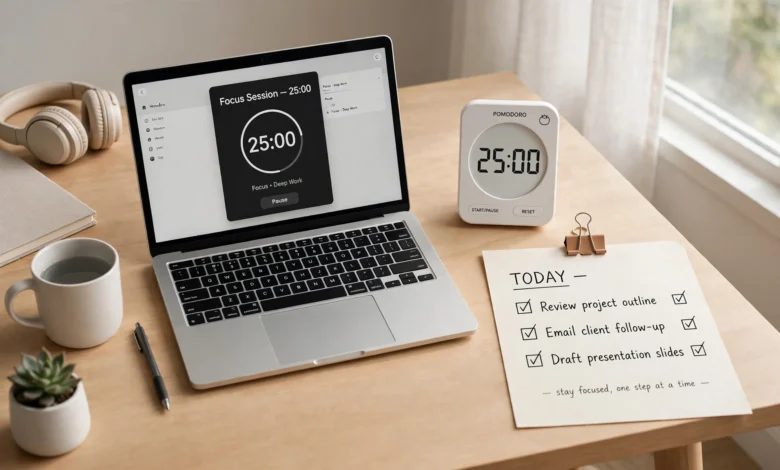
The Pomodoro Technique is simple. Set a timer for 25 minutes and work on one thing only. When the timer rings, take a 5-minute break. After four rounds, take a longer break of 15 to 30 minutes.
It works because 25 minutes feels manageable, even for a task you dread. The timer also creates a mini deadline, which sharpens your focus. If 25 minutes feels too long, start with 10. The point is to make beginning easy, not to follow the rules perfectly.
5. Remove Distractions Before You Start
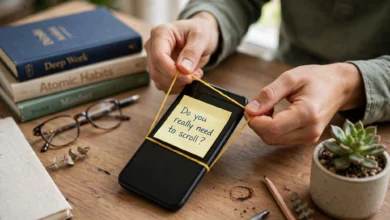
You cannot rely on willpower to ignore your phone for an hour. Instead, set up your environment so distraction takes more effort than work:
- Put your phone in another room or in a drawer.
- Close every browser tab you don’t need for the task.
- Use a website blocker during focus sessions.
- Turn off email and chat notifications.
- Tell people around you when you are not available.
Small amounts of friction go a long way. If checking social media requires walking to another room, you will do it far less often.
6. Make a Specific Plan with “When and Where”
“I’ll work on my presentation this week” is a wish, not a plan. A stronger version sounds like this: “On Tuesday at 9 a.m., at my desk, I will outline the first five slides.” Psychologists call this an implementation intention, and studies show it makes people far more likely to follow through.
The specific time and place remove the daily decision of when to start, which is exactly the moment procrastination likes to sneak in.
7. Set Your Own Deadlines
Far-off deadlines don’t feel real. Break long projects into mini deadlines and put them on your calendar. Even better, make them visible to someone else. Tell a coworker you’ll send a draft by Thursday, or agree to show a friend your progress on Sunday.
This kind of accountability works because most of us care more about letting someone else down than about breaking a promise to ourselves.
8. Eat the Frog (Do the Hardest Thing First)
Your energy and willpower are usually highest early in the day. Spend that window on the task you most want to avoid. Once it’s done, the rest of the day feels lighter, and you stop carrying the dread around for hours.
If mornings aren’t your peak, use the same idea with whatever time of day you think most clearly.
9. Lower the Bar for the First Draft
If perfectionism is your main trigger, give yourself permission to do bad work first. Write a rough draft you would never show anyone. Sketch a messy plan. Record a first take you plan to throw away.
Editing something that exists is much easier than creating something perfect from nothing. Good work almost always comes from improving a weak first attempt.
10. Reward Progress, Not Just Results
Boring tasks need a reason to start. Pair them with something you enjoy, like your favorite playlist or a good coffee you only drink while doing paperwork. Researchers call this temptation bundling.
Also celebrate small wins. Finishing one section of a big project deserves a short walk or a few minutes of something fun. Rewards teach your brain that working on hard things feels good, which is the opposite of what procrastination teaches it.
11. Forgive Yourself and Practice Self-Compassion
This one surprises people, but it may be the most important habit on the list. Beating yourself up after you procrastinate makes you feel worse, and feeling worse makes you more likely to avoid the task again. It is a loop.
Self-compassion breaks that loop. When you slip, acknowledge it, remind yourself that everyone does this, and decide on the next small step. Research from the Sirois lab even led to a free compassion-focused toolkit called TEMPO from Durham University, built to help people manage the shame and negative feelings that drive delay. Kindness is not letting yourself off the hook. It is how you get back on track faster.
How to Build a Daily Routine That Helps You Stop Procrastinating
One good day is easy. The real goal is a routine that keeps you moving when your mood, energy, or schedule is off. A simple system beats a complicated one, because you will actually use it.
Plan Tomorrow Tonight
Spend five minutes at the end of each day writing your to-do list for tomorrow. Pick your top three priorities and put the hardest one first. When you sit down in the morning, there is no decision to make. You just start.
Protect Your Focus Blocks
Block out one or two 60 to 90 minute windows on your calendar for deep work and treat them like meetings. During these blocks, you work on your priorities with distractions removed. Everything else, including email and admin, goes into the gaps between.
Track Your Patterns for One Week
For seven days, jot down each time you notice yourself avoiding a task. Write what the task was, what you did instead, and how you felt. Patterns show up fast. You might find that you always delay tasks involving phone calls, or that your productivity drops sharply after lunch. Once you know your patterns, you can plan around them.
What to Do When You Fall Off Track
You will have bad days. Everyone does. The difference between people who overcome procrastination and those who don’t is how quickly they recover. When you notice you have been avoiding something:
- Pause and name the feeling. “I’m anxious this won’t be good enough.”
- Remind yourself that the feeling is temporary and you can work while feeling it.
- Pick the smallest possible next step.
- Set a timer for 10 minutes and do only that step.
- Notice how you feel afterward. Usually, it’s relief.
This five-step reset takes less time than scrolling through one social media feed, and it gets you back to real work.
When Procrastination Might Be Something Bigger
For most people, the habits above are enough. But sometimes chronic procrastination is a symptom rather than the main problem. It can be linked to ADHD, depression, anxiety disorders, or burnout. A few signs it may be worth talking to a doctor or therapist:
- You have tried many strategies for months and nothing sticks.
- Delay is causing serious problems at work, school, or home.
- You feel constantly exhausted, hopeless, or unable to enjoy things you used to like.
- You have struggled with focus and follow-through for as long as you can remember.
Getting support is not a sign of weakness. Treating an underlying issue often makes every other strategy in this article work much better.
Frequently Asked Questions About How to Stop Procrastinating
How do I stop procrastinating right now?
Pick the smallest possible step on the task you are avoiding, set a timer for five or ten minutes, and do only that step. Put your phone out of reach first. Starting small takes the pressure off and usually builds enough momentum to keep going.
Is procrastination a sign of laziness?
No. Lazy people don’t care whether the work gets done. Procrastinators usually care a lot, which is why they feel guilty. Research points to emotion regulation, not a lack of effort, as the main driver.
How long does it take to break the procrastination habit?
It varies, but most people notice a difference within two to three weeks of using one or two strategies consistently. Lasting change takes a few months, and occasional slips are normal along the way.
What is the best technique to beat procrastination?
There is no single best method. Breaking tasks into small steps, the Pomodoro Technique, and practicing self-compassion have the strongest track records. Try a few and keep the ones that suit how you work.
Can procrastination ever be useful?
Sometimes a short, deliberate delay helps you gather information or let an idea develop. That is strategic waiting, and it feels calm. Procrastination is different because it comes with stress and guilt.
Conclusion
Learning to stop procrastinating comes down to one shift: treating delay as an emotional habit rather than a character flaw, and then making the first step so small that the feeling loses its grip. Understand your triggers, shrink your tasks, use tools like the two-minute rule and the Pomodoro Technique, set up your space to limit distractions, plan with a specific time and place, and add outside accountability when deadlines feel distant.
Above all, respond to slips with self-compassion instead of criticism, because guilt feeds the cycle while kindness breaks it. Choose one habit from this guide, use it today, and add another next week, and you will find that getting started gets a little easier every time.